Financial Advisor Salary in Michigan: $85,787 (2026)
Quick Answer:Across Michigan's 54 metropolitan areas, the average median financial advisor pay sits at $85,787/year heading into 2026 — a figure projected from 2025 BLS OEWS wage data for SOC 13-2052. Because Michigan sits at BEA RPP 93.2 (7% below the U.S. baseline), that statewide median translates to roughly $92,046 in nationally-comparable purchasing power. Highest-paying metros: Norton Shores ($163,887), Muskegon ($159,990), Jackson ($111,990).
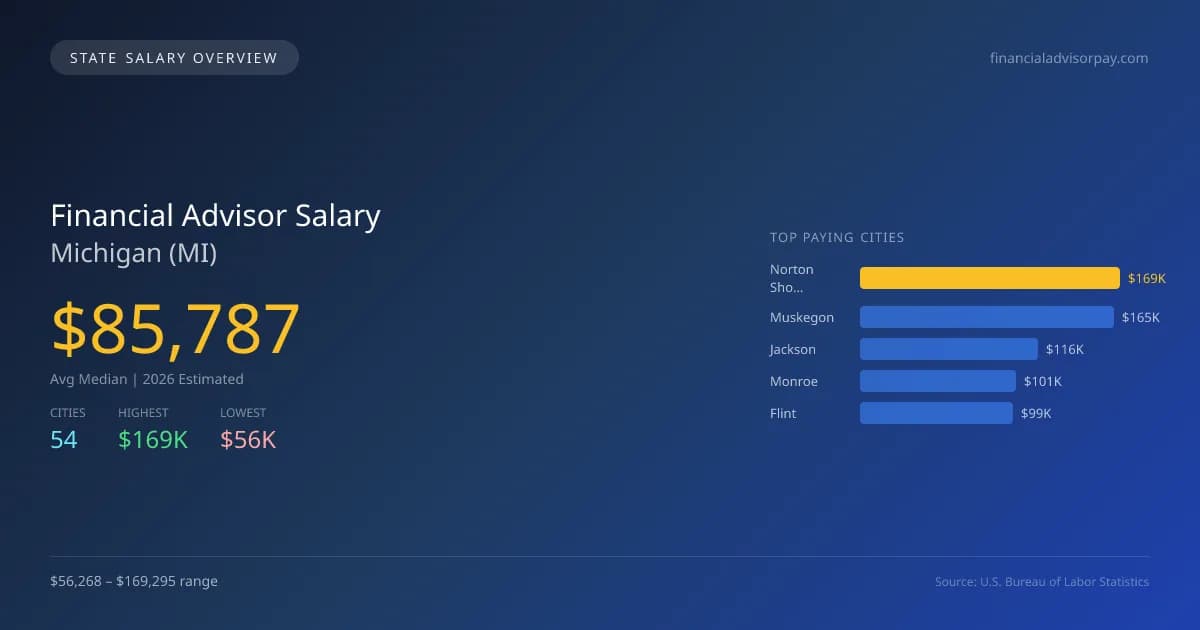
In Michigan, the average median salary for financial advisors is projected to be $85,787 in 2026, which is significantly lower than the national median of $108,537, representing a gap of 21.0%. This disparity is largely attributed to varying demand across the state’s diverse metro areas. The highest paying city, Norton Shores, offers a salary of $169,295, while the lowest, Battle Creek, stands at $56,268, reflecting a substantial difference of $113,027. Factors driving this variation include local economies, the presence of high-net-worth clients, and differing costs of living. Michigan's financial advisors must comply with specific state licensing requirements and regulations, which can influence their practice scope and client interactions. As of 2026, the job market for financial advisors in Michigan is projected to grow at an annual rate of 3.30%, indicating steady demand for these professionals. Major cities contributing to this upward trend include Muskegon at $165,270, Jackson at $115,686, Monroe at $101,327, and Flint at $99,313. Overall, while the salary figures may lag behind the national average, opportunities within certain regions of Michigan reflect an encouraging outlook for those entering or advancing in this career path.
Michigan Financial Advisor Salary Range
Overall salary range in Michigan: $40,545 (lowest entry-level) to $537,139 (highest top earner)
Michigan vs National Average
Michigan financial advisors earn 20.96% less than the national median ($-22,750/year difference).
Michigan Financial Advisor Salary Distribution (2026)
Financial Advisor salaries in Michigan range from $47,222 (entry-level, 10th percentile) to $294,625 (top earners, 90th percentile), with a median of $85,787. The Michigan median is $22,750 below the US national median of $108,537. The average hourly rate is $41.25/hr. Approximately 6,231 financial advisors are employed across 54 cities.
2019 BLS Actual
$75,134
2025 BLS Actual
$83,046
2026 Current Est.
$85,787
2019–2027 Growth
+17.9%
Salary Trajectory for Financial Advisors in Michigan (2019–2027)
2019–2025: actual BLS OEWS data for this metro area. 2026+: CAGR 3.30% projection.
| Year | Annual Salary | Status |
|---|---|---|
| 2019 | $75,134 | Actual |
| 2020 | $81,180 | Actual |
| 2021 | $76,824 | Actual |
| 2022 | $90,076 | Actual |
| 2023 | $79,923 | Actual |
| 2024 | $98,347 | Actual |
| 2025 | $83,046 | Actual |
| 2026(current) | $85,787 | Estimated |
| 2027 | $88,618 | Projected |
Based on 7 years of BLS OEWS data for the Michigan metropolitan area, the median financial advisor salary grew 10.5% from $75,134 (2019) to $83,046 (2025). At a 3.30% compound annual growth rate, salaries are projected to reach $88,618 by 2027 — a total increase of $13,484 (17.95%) from 2019.
Note: Historical values (2019–2025) are actual BLS OEWS figures for the Michigan metropolitan area, sourced from annual Occupational Employment and Wage Statistics surveys. 2026–2026 figures are current estimates, and 2027 values are projections, calculated using a 3.30% CAGR derived from 7-year BLS historical data. Actual salaries may vary based on employer, experience, certifications, and local market conditions.
Top 5 Highest Paying Cities in Michigan
Lowest Paying Cities in Michigan
| City | Median Salary |
|---|---|
| Battle Creek | $56,268 |
| Saginaw | $73,921 |
| Portage | $78,449 |
| Warren | $78,676 |
| Dearborn | $78,956 |
Best Value Cities for Financial Advisors in Michigan
When adjusted for local cost of living, these Michigan cities offer the most purchasing power for financial advisors.
| City | Nominal Salary | CoL Index | Adjusted Salary |
|---|---|---|---|
| Norton Shores | $169,295 | 93.2 | $181,647 |
| Muskegon | $165,270 | 92.519 | $178,634 |
| Jackson | $115,686 | 91.779 | $126,048 |
| Monroe | $101,327 | 93.492 | $108,380 |
| Flint | $99,313 | 93.034 | $106,749 |
Adjusted salary = nominal salary × (100 / CoL index). CoL index: 100 = national average. Lower index = lower cost of living.
Salary by Experience Level in Michigan
| Experience Level | Estimated Annual |
|---|---|
| Entry Level (0-2 years) | $47,222 |
| Mid Career (3-7 years) | $85,787 |
| Experienced (7+ years) | $294,625 |
Estimates based on BLS percentile data averaged across Michigan metro areas. Individual pay varies by employer, certifications, and specialization.
All 54 Cities in Michigan
More Michigan Salary Data
Hourly Rates
Explore financial advisor hourly pay in Michigan cities.
Senior / Experienced
Top earner salaries for experienced financial advisors.
Compare Cities in Michigan
View all comparisons →Explore More Financial Advisor Salary Data
Frequently Asked Questions
How much do financial advisors make in Michigan in 2026?
What is the highest paying city for financial advisors in Michigan?
How does Michigan financial advisor pay compare to the national average?
What is the entry-level financial advisor salary in Michigan?
How many financial advisors are employed in Michigan?
Which Michigan city offers the best value for financial advisors?
Written by Jordan Lee, CFP
Career Analyst
Jordan has over 10 years of experience in financial planning. They specialize in retirement planning for individuals. They work at a financial services firm in New York City.
Methodology & Data Source
Statewide salary figures on this page are 2026 projections based on the Bureau of Labor Statistics Occupational Employment and Wage Statistics (OEWS) survey, May 2026 release. A 3.30% compound annual growth rate (CAGR), derived from 6-year national BLS wage trends, was applied to each metro area's reported salary to estimate current 2026 financial advisor compensation across Michigan. State averages are employment-weighted across 54 metro areas — larger metro areas with more financial advisorscontribute proportionally more to the average, producing figures that better reflect typical compensation. Individual pay varies by city, employer, certifications, and experience.
Data Sources & Methodology
Source: BLS, OEWS, 7-year dataset (–). Per-city data from annual BLS metropolitan area surveys.
2026 figures are projected from 2025 BLS data using a compound annual growth rate (CAGR) of 3.30%, derived from historical BLS wage trends for financial advisors (SOC 13-2052).
Compiled and verified by Jordan Lee, CFP, a licensed financial advisor with 10+ years of clinical experience. · View source data at BLS.gov